
Criminal Court Cases in Scott County
Scott County criminal court cases divide between General Sessions Court and Criminal Court. General Sessions meets at the Scott County Justice Center each weekday, with court beginning at 9 a.m. It handles misdemeanor matters, arraignments, and preliminary hearings in felony cases. Judge Scarlett Ellis also presides over Juvenile Court and Drug Court. When a felony continues after the first court stage, the case can move into Scott County Criminal Court in Tennessee's Eighth Judicial District. That district also covers Campbell, Claiborne, Fentress, and Union counties.
Circuit Court Clerk Donnie Phillips keeps the local dockets and is the correct records contact. The clerk can help identify whether a file belongs to General Sessions or Criminal Court. The County Clerk and Clerk & Master handle other county functions and are not substitutes for the criminal docket counter. A person who starts at the historic 1906 courthouse may also be sent elsewhere because the courts, jail, sheriff, and trial-court clerk functions moved into the Justice Center when it opened in 2008.
Scott County Criminal Court Roles
Each Scott County court answers a different case question. General Sessions shows the first local events and handles misdemeanors within its jurisdiction. It may also show that a felony was bound over, which means the matter was sent forward for grand-jury consideration. It does not mean guilt was decided. Criminal Court holds the felony prosecution file after indictment or transfer, including pleadings, motions, plea or trial results, and sentencing entries.
| Court or Office | Scott County Criminal Role | Access Channel |
|---|---|---|
| General Sessions Court | Misdemeanors, arraignments, and felony preliminary hearings | Circuit Court Clerk, (423) 663-2440 |
| Criminal Court | Felony indictments, pleas, trials, and sentences | Circuit Court Clerk at the Justice Center |
| Juvenile Court | Juvenile delinquency matters, generally confidential | Clerk guidance under juvenile-access law |
| Drug Court | Treatment and problem-solving docket | Ask the clerk for current eligibility and schedule |
| Appellate Courts | Review of appealed trial-court matters | Tennessee Public Case History |
The official Scott County General Sessions Court page supplies the local jurisdiction, schedule, and clerk route. It is the best first check when the court level is not yet clear.
The U.S. District Court for the Eastern District of Tennessee is a separate federal court that serves Scott County. The official federal court view below reinforces that a federal prosecution will not appear merely because someone asks the Scott County clerk.
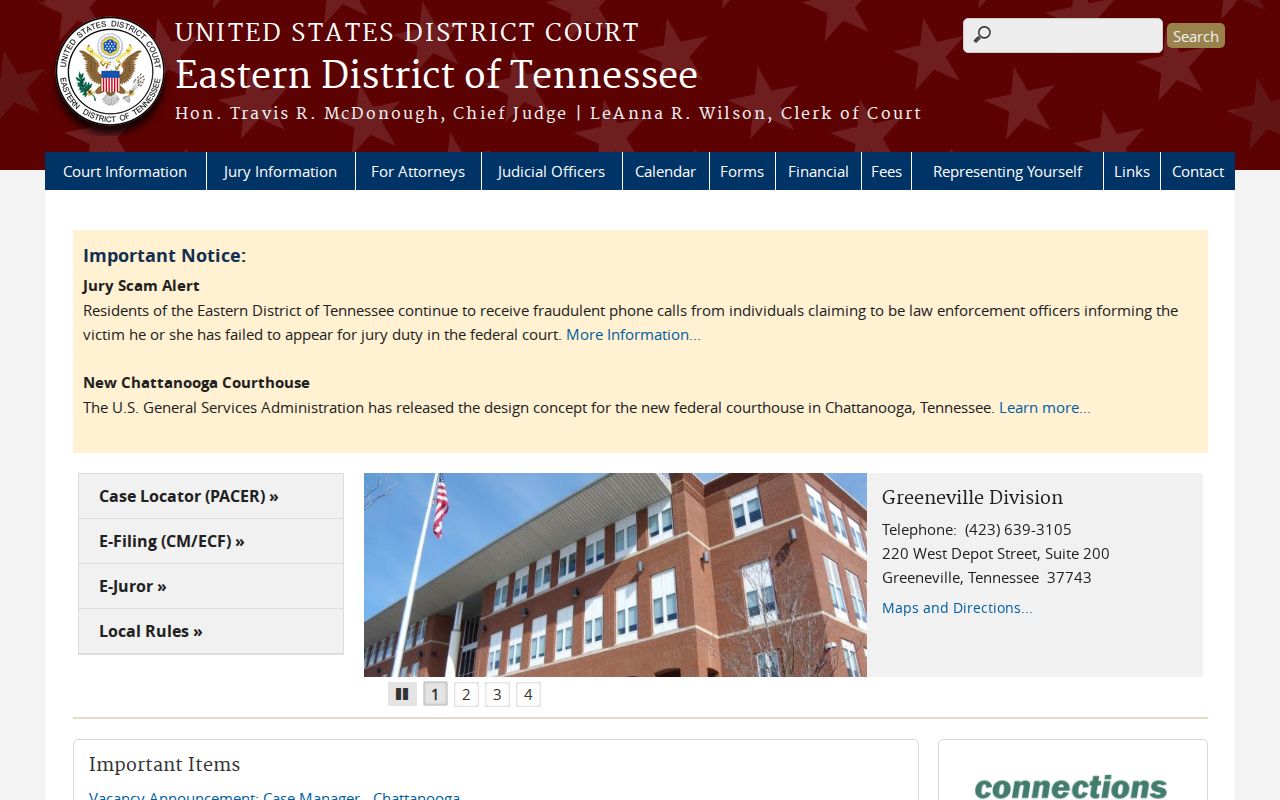
Federal dockets belong in PACER and the federal clerk system, while Scott County trial dockets remain with the local Circuit Court Clerk.
Scott County Case Record Searches
Tennessee has no public statewide trial-court database that covers every Scott County General Sessions and Criminal Court file. Start with the Circuit Court Clerk at (423) 663-2440. The office is open from 8:00 a.m. to 4:30 p.m. at the Scott County Justice Center, 575 Scott High Drive, Huntsville, TN 37756. A precise request limits mistaken matches and helps the clerk locate older material.
- Give the clerk the case number when known. If it is not known, provide the accurate party name and an approximate filing or arrest year.
- Ask whether General Sessions or Criminal Court holds the Scott County case and whether the docket or index is open for inspection.
- Identify the exact items needed, such as the charging paper, docket entries, judgment, sentence, or a certified disposition.
- Ask whether copies can be emailed or mailed and request the current plain-copy, certified-copy, or archive-search cost before ordering. Scott County has not posted those fees online.
- If the matter was appealed, use Tennessee Public Case History and match its trial-court number back to the local file.
Call before traveling for archived or certified Scott County criminal case records. The county has not published a self-service terminal guide, a trial-document paywall, or a complete remote-document policy.
Scott County Appellate Case Search
The Tennessee Public Case History search is useful only after a Scott County case reaches an appellate court. A blank result does not show that no trial case exists. Search by the fields the judiciary actually supplies, then read the originating trial court and trial-court number to connect the appeal back to the Circuit Court Clerk's file.
| Field | Type | Required | Use |
|---|---|---|---|
| Case Number | Text | No | Use an appellate number such as the published Tennessee format |
| Case Style | Text | No | Search the caption used by the appellate court |
| Party Name | Text | No | Find an appeal when the number is unknown |
| Business/Organization | Text | No | Search an organization named as a party |
| Advanced Search | Control | No | Narrow the appellate query with added criteria |
The judiciary's Public Case History explanation describes the appellate system and its record scope.
The official Tennessee appellate interface is shown below from its source.
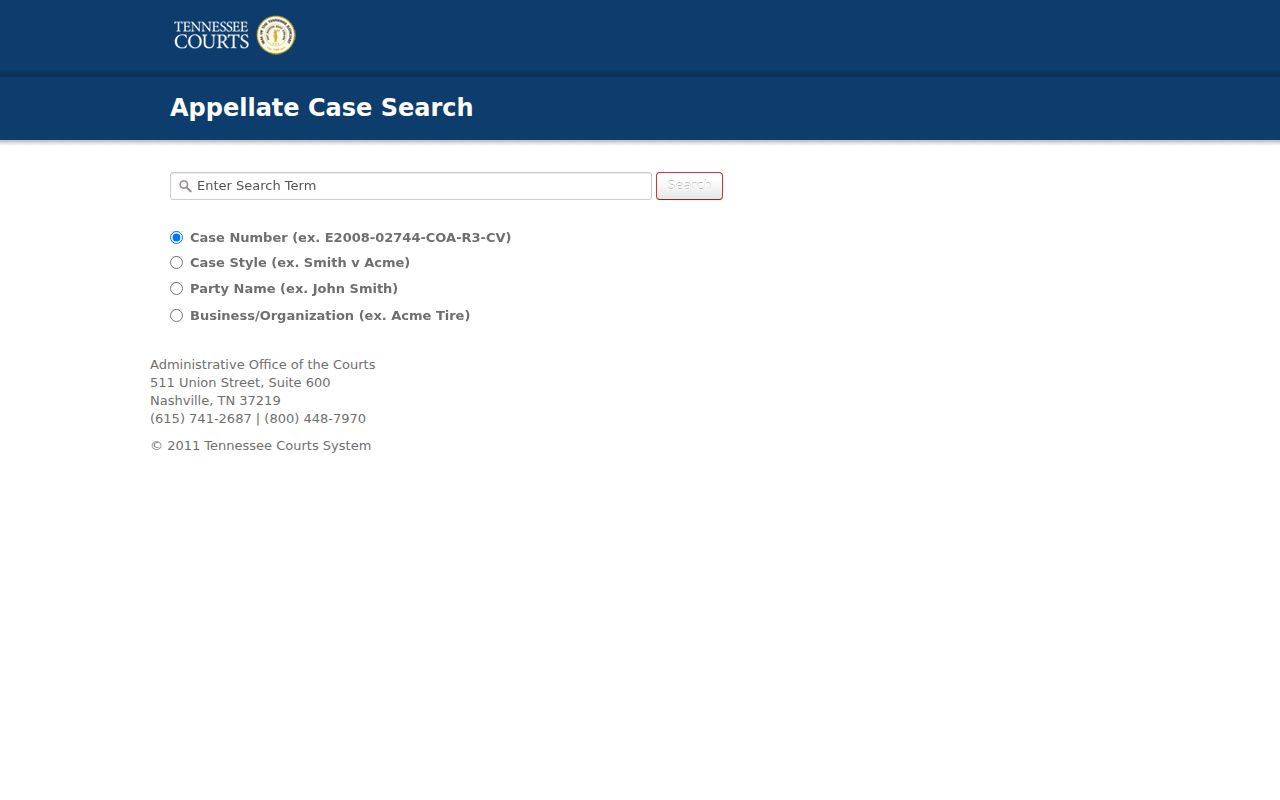
Its case overview, milestones, parties, document history, and record information are appellate fields, not a Scott County online trial-file inventory.
Note: A Scott County case with no appeal will not appear in this appellate search, so confirm the trial file with the local clerk.
What a Criminal Case File Contains
A Scott County criminal case file records what prosecutors filed and what the court did. Typical fields include the docket number, filing date, court, judge, party labels, counsel, charge and statute, bond orders, scheduled hearings, motions, plea, verdict or disposition, judgment, sentence, costs, probation orders, warrants or capias entries, and an appeal notice. Availability still depends on the file and any lawful restriction.
| Case Number and Court | Identifies the docket and whether General Sessions or Criminal Court holds it. |
|---|---|
| Charging Document | States the charge filed in court, which may differ from the booking label. |
| Docket Entries | Track filings, settings, motions, warrants, and court action over time. |
| Hearing Dates | Show scheduled or completed proceedings without proving their outcome by themselves. |
| Disposition and Judgment | Record dismissal, nolle prosequi, acquittal, plea, or conviction as entered. |
| Sentence and Conditions | Show punishment, costs, probation terms, and other conditions in the judgment. |
When the outcome matters, request the disposition or judgment rather than relying on an old arrest entry. The detailed Scott County Arrest Search explains why the jail record can remain even after a charge changes or ends.
Scott County Criminal Docket Terms
Short docket terms can change the meaning of a Scott County court case lookup. Read the full entry and its date before drawing a conclusion. These terms describe procedural results, not all the facts behind them.
- Bound over
- General Sessions sent the matter for grand-jury consideration. It is not a conviction.
- Nolle prosequi
- The prosecution ended that charge at that point. It is not the same label as an acquittal.
- No true bill
- The grand jury did not return an indictment on the proposed charge.
- Capias
- A court order directing that a person be taken into custody, often tied to a missed event or violation matter.
- Disposition
- The recorded result of the charge, such as dismissal, plea, verdict, or another final court action.
Dismissal, nolle prosequi, no true bill, and not-guilty outcomes may support an expungement inquiry under Tennessee law, but eligibility turns on the precise case and statute.
Criminal Case Stages in Scott County
A Scott County prosecution starts with charging papers and an early General Sessions event. Misdemeanor cases may stay there. A felony may receive a preliminary hearing and then move toward grand-jury review and Criminal Court. The filed charge can change from the wording recorded at arrest, and an indictment still is not a finding of guilt.
Case flow: Charges Filed › Arraignment › Pretrial › Plea or Trial › Disposition › Sentencing
The District Attorney prosecutes the case, but the public clerk docket remains the proper source for filed court events. Prosecutorial work product, victim data, and active investigation material may not be part of the public file. The Public Defender represents eligible people after appointment and does not provide a public background-check service.
Scott County Federal Court Records
A federal case follows a different path. Scott County lies within the Eastern District of Tennessee, and PACER is the federal judiciary's official docket and filed-document service after registration. Its live fee schedule controls. TORIS, the Scott County clerk, and Tennessee appellate Public Case History do not replace PACER for a federal prosecution.
The official PACER access page appears below from the federal judiciary.
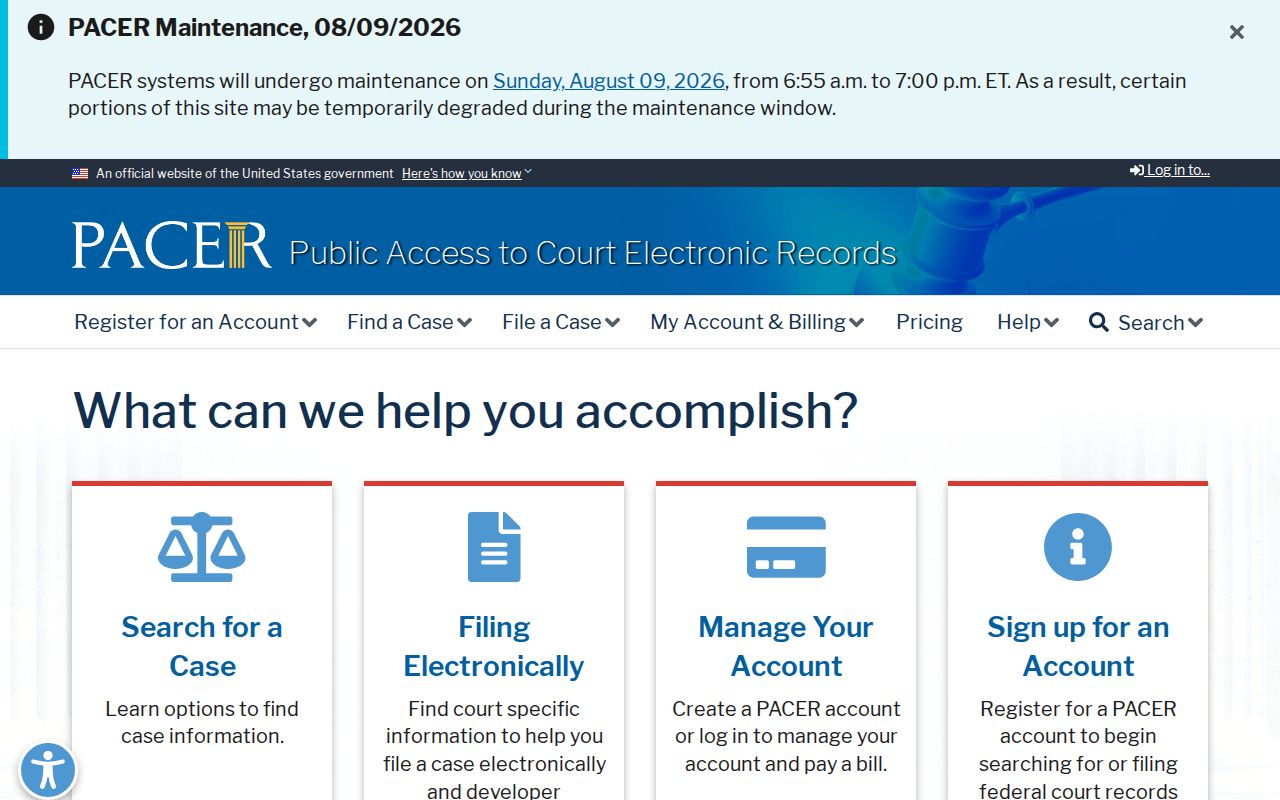
Use the court named on the docket to keep a federal filing separate from state and county case records.
Note: A federal docket and a Scott County Criminal Court docket are separate records even when events concern the same person.
Access Rules for Case Records
The Tennessee Public Records Act provides broad access duties, but it does not make every Scott County criminal case detail public. Tenn. Code Ann. §§ 10-7-503 and 10-7-506 address inspection and copies, while § 10-7-504 collects confidentiality provisions. Judicial records also operate under court rules and specific statutes. Juvenile court and juvenile law-enforcement records receive special protection under §§ 37-1-153 and 37-1-154. Victim-identifying facts, medical material, sealed records, and data covered by a court order may also be restricted or redacted.
If the clerk withholds material, ask for the legal basis. A request may seek an existing record, but it does not require an office to create a new report or answer a legal question. Inspection and copies are separate. Tennessee's public-record right is framed for Tennessee citizens, and a custodian may seek proof of citizenship or clarification that reasonably identifies the file.
Scott County Expunged Case Follow-Up
Expungement requests return to the clerk of the court that disposed of the Scott County case. First obtain the exact docket number and disposition from the Circuit Court Clerk. Then determine whether the matter was in General Sessions or Criminal Court and which current petition form applies. Charges ending in dismissal, nolle prosequi, no true bill, acquittal, or an arrest without charge may fall within the cleanest eligibility group under Tenn. Code Ann. § 40-32-101. Judicial-diversion matters have a separate statutory path.
The Tennessee courts' expungement guidance supplies official explanations and forms. The source view below marks the state-court route for Scott County petitioners.
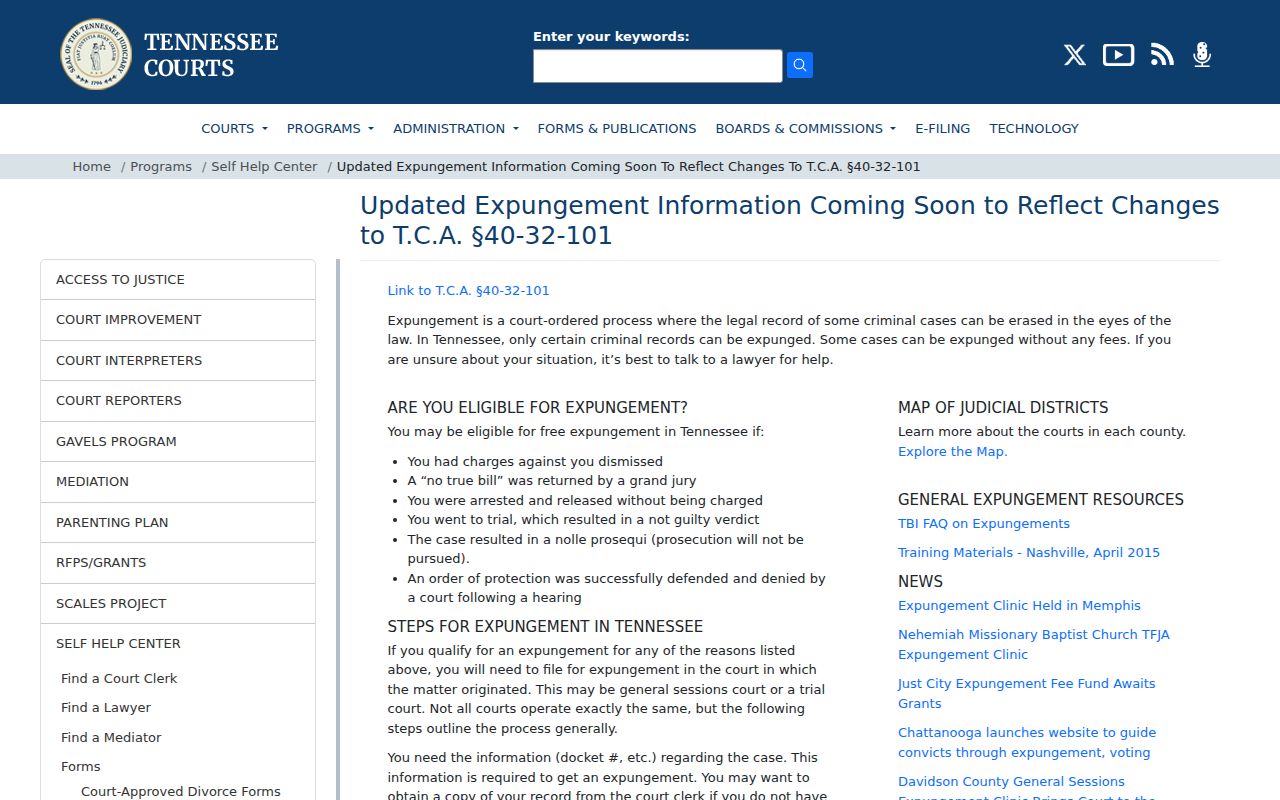
After a signed order, keep certified copies and allow each system time to process the change. Sealed, confidential, redacted, and expunged are not synonyms, so confirm the effect of the actual order.
Note: Ask the Scott County clerk for the current form and fee because eligibility and cost depend on the statutory route.