
Scott County Criminal History Checks
No single database holds a complete Scott County criminal history. The official ISOMS roster answers recent custody questions. The Circuit Court Clerk maintains the local prosecution file, and the Tennessee Bureau of Investigation keeps the fingerprint-supported state repository. Start with the channel that fits the question. A recent arrest calls for ISOMS and the arresting agency. A filed charge or final outcome calls for the clerk. A broader Tennessee record calls for TORIS. Search with an accurate name, spelling variants, an approximate date, and a case or booking number when one is known.
A careful check separates identity from outcome. ISOMS does not publish a full date of birth in its visible field set, and TORIS remains a name-based possible-match product even though the repository is built from fingerprint submissions. The court clerk can help distinguish similar names through a docket number and filing year. Use each result as a lead to the record that created it, not as a substitute for that source.
- Open the current or last-72-hours ISOMS view for recent Scott County custody.
- Use first name, last name, and the Released control to widen the local search.
- Call the Circuit Court Clerk with the name, date range, and any case number to locate filed charges.
- Order TORIS when the question extends beyond Scott County to the Tennessee repository.
- Request a certified disposition from the court that decided the case when formal proof of the outcome is needed.
Scott County Records Use Three Channels
Scott County booking data, court files, and TBI histories are related but not interchangeable. Jail staff record intake, charges supplied at booking, bond entries, the arresting department, and release information. Court clerks record what prosecutors filed and how the judge resolved it. TBI links fingerprint-supported arrest cycles to dispositions that courts successfully report. A charge may be amended or dismissed after booking, and a disposition can lag while agencies match it to an arrest cycle.
| Channel | Best Answer | Main Limit |
|---|---|---|
| Scott County ISOMS | Current and recent jail custody, charges, bond, and release | Not guilt, not statewide, and not a full life history |
| Circuit Court Clerk | Filed charges, hearings, disposition, and sentence | Some files require a call or counter request |
| TBI TORIS | Tennessee repository history based on supplied identifiers | Name-based, Tennessee-only, and aliases are excluded |
The most reliable answer often comes from comparing all three. A mismatch does not by itself prove an error. First check whether the records describe different stages of the same event.
Official Background Checks in Tennessee
The Tennessee Open Records Information Services, known as TORIS or TN-FlexCheck, is TBI's public name-check channel. Any requester may order the Tennessee-only result. It costs $29, is nonrefundable, does not include aliases, and excludes juvenile material unless the person was transferred for adult prosecution. A possible match means the supplied identifiers may correspond to a repository record. It is not identity confirmation through newly collected prints.
The official TORIS start screen shows the product's scope and entry controls.
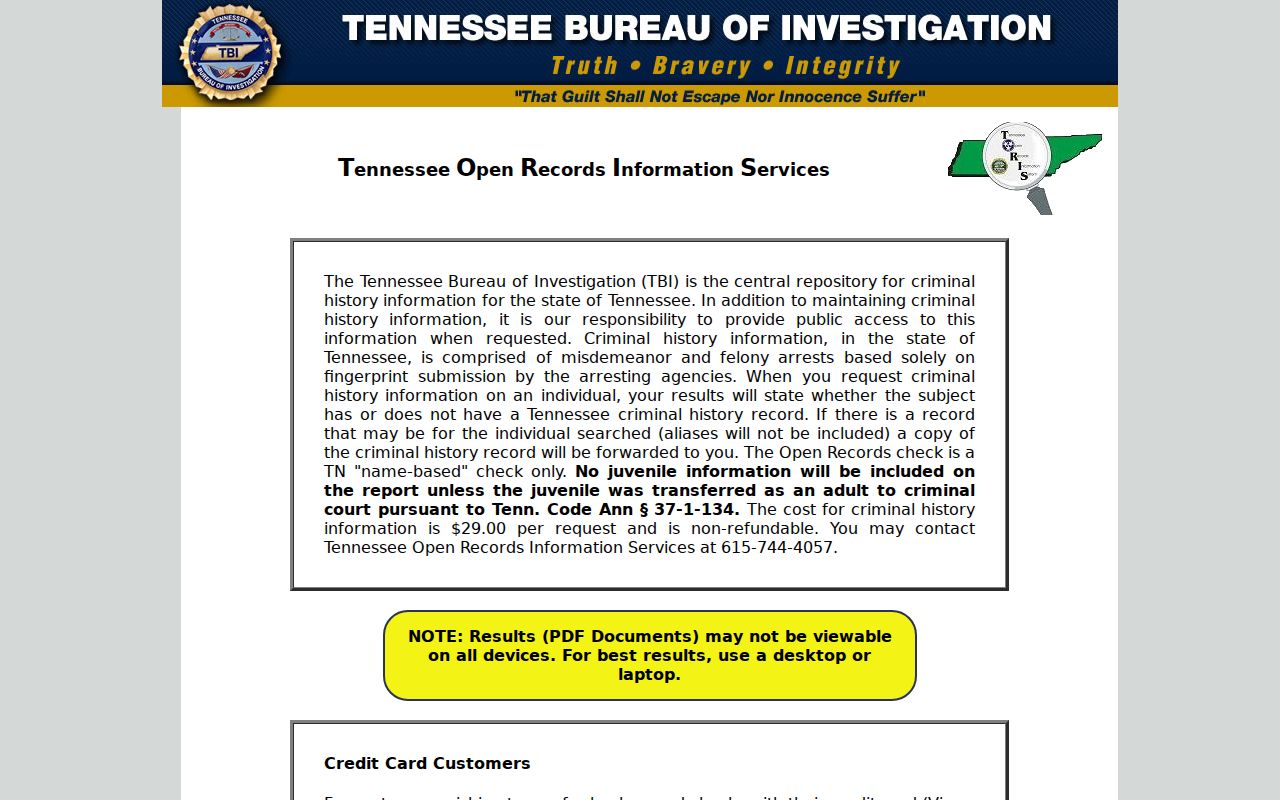
That interface is the state repository route, not a shortcut to the Scott County clerk's pleadings or the sheriff's narrative report.
Authorized state and FBI fingerprint checks use IdentoGO by IDEMIA through Tennessee Applicant Processing Services. The authorizing program supplies an OCA code, and the applicant schedules electronic fingerprinting. Program fees vary, so a price tied to one license or agency should not be treated as universal. No official enrollment site inside Scott County was confirmed in the research. Use the live scheduler and the applicant's ZIP when an appointment is required. A person reviewing their own federal identity history can instead use the FBI's fingerprint-based EDO route.
Search Scott County ISOMS Records
The free Scott County inmate search exposes a small but useful set of controls. First Name and Last Name accept the name query. A Released control includes or filters records for people no longer in current custody. The interface does not state its retention period or exact-match behavior, so try spelling variants and do not treat a blank result as proof that no booking occurred.
| Field | Use | Limit |
|---|---|---|
| First Name | Search a given name alone or with a surname | Exact and wildcard behavior is not published |
| Last Name | Primary surname key | Aliases and spelling errors can cause misses |
| Released | Look beyond the current-inmate list | Public retention coverage is not stated |
| Search / reset control | Run or clear the query | Verify the second label in the live interface |
Read each displayed field on its own terms. A zero bond entry can reflect a hold, missing data, or charge-level setup. It does not always mean release is available.
Kinds of Criminal Records
The office that creates a record usually remains the best source for it. The sheriff or municipal police keep incident and arrest narratives. Jail staff keep booking data. General Sessions and Criminal Court files are held through the Circuit Court Clerk. TBI compiles fingerprint-supported Tennessee history, while TDOC publishes a correctional locator and TBI separately manages the public sex offender registry.
- Incident and arrest reports describe an agency's allegations, observations, evidence, and basis for custody.
- Booking records show the jail's intake, charge, bond, arresting-agency, and release fields.
- Court case files show filed charges, motions, pleas, rulings, disposition, and sentence.
- TBI histories connect qualifying Tennessee arrest cycles with linked court outcomes.
- Correctional and registry records answer narrow custody, supervision, or statutory registration questions.
Warrants form another category, but Scott County has no official public active-warrant name database. A served warrant-related charge may appear in ISOMS. Current status should be confirmed through the sheriff or the issuing court.
Scott County Criminal Record Counters
The Scott County Justice Center brought the courts, jail, sheriff, clerks, and district attorney into one modern complex in 2008. Their records remain separate. The Sheriff's Department handles custody and its own incident material. Circuit Court Clerk Donnie Phillips is the docket contact for General Sessions and Criminal Court. The district attorney's work file is not a replacement for the public clerk docket and can contain restricted work product or victim information.
Scott County Sheriff's Department
Scott County Justice Center
575 Scott High Drive
Huntsville, TN 37756
(423) 663-3111
Published hours: 8:00 a.m. to 4:30 p.m.
Circuit Court Clerk
General Sessions and Criminal Court records
Scott County Justice Center
Huntsville, Tennessee
(423) 663-2440
Call before travel for certified or archived files.
The historic 1906 courthouse still stands, but it is not the main criminal-record counter. It houses other county offices. A visitor seeking a docket may be redirected to the Justice Center, so confirm the destination before leaving home.
Scott County Criminal Records: What They Contain
Contents vary by source. ISOMS can show name, age, custody class, race/sex code, intake date, city, arresting department and officer when populated, release date, charges, and bond. A court file adds the docket number, filing events, judge, counsel, motions, plea, verdict or other disposition, judgment, sentence, costs, and supervision orders. TORIS focuses on identifiers, arrest cycles, charges, and linked outcomes received by TBI.
| Name & Identifiers | Displayed name and source-specific demographic fields used to distinguish records |
|---|---|
| Arrest / Booking Data | Intake time, arresting agency, officer when listed, charges, bond, and release |
| Charges & Statutes | Alleged or filed offense labels, legal citations, and later amendments |
| Disposition | Dismissal, nolle prosequi, acquittal, plea, conviction, or other final action |
| Sentence | Jail or prison term, probation, fines, costs, and related orders where public |
| Custody / Supervision Status | County jail, TDOC incarceration, probation, parole, release, or inactive status |
Missing fields matter. The accessible ISOMS text did not show a booking number, full date of birth, physical-description fields, court date, housing pod, or mugshot. Do not infer details the portal does not publish.
Scott County Booking Records Reach TBI
A local arrest creates a chain of records. The arresting officer writes the incident or arrest report. Jail staff create the booking entry when custody begins. Fingerprints for qualifying misdemeanor and felony arrests feed TBI's repository. General Sessions handles the initial court stage, while an indicted felony proceeds in Criminal Court. The clerk then reports the final disposition through Tennessee's criminal-history pipeline.
Record flow: Arresting agency › Scott County booking › General Sessions or Criminal Court › TBI repository.
This sequence explains why records can disagree for a time. The jail may still display the initial charge after a prosecutor changes it. TBI may not yet show a disposition if identifiers are incomplete or the outcome cannot be linked to the arrest cycle. The clerk's filed judgment controls the court outcome.
The TN-FlexCheck requestor form collects the requester's identifying and contact details before the subject search.
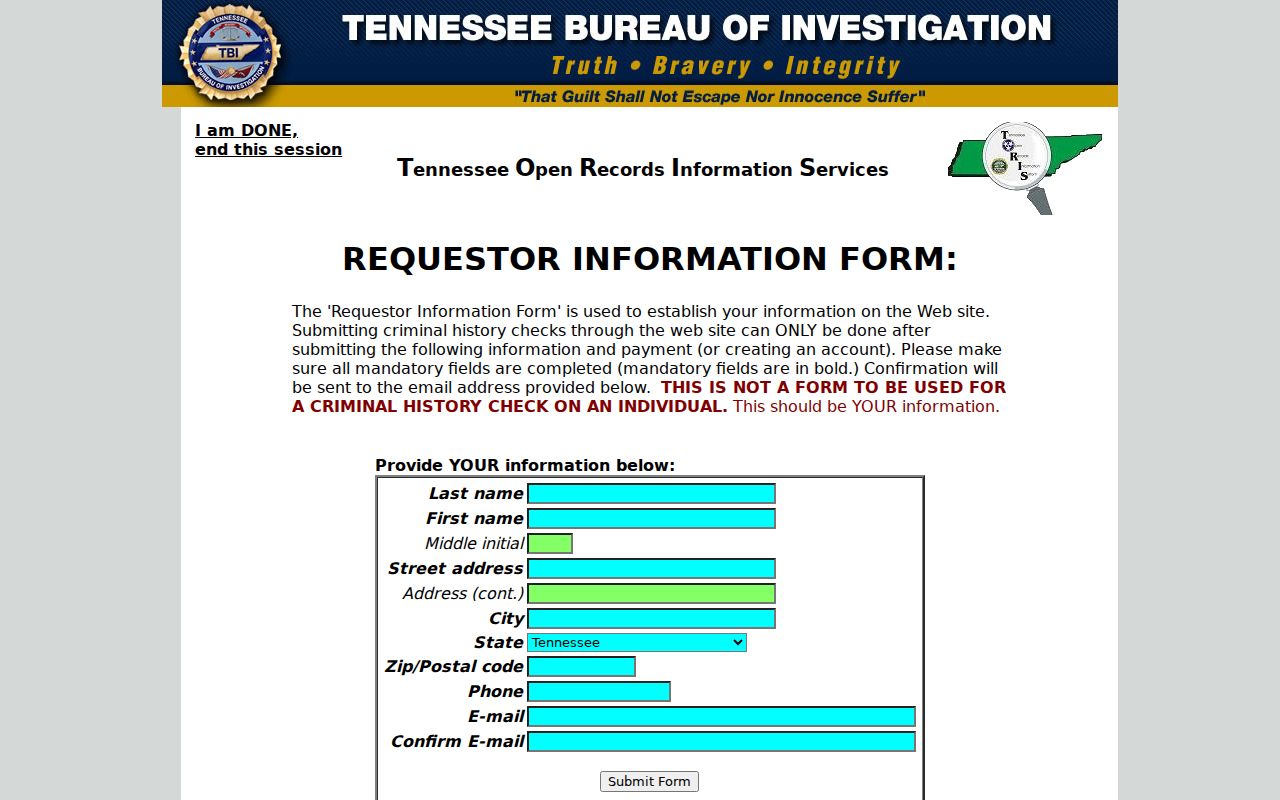
The form's sequence is another reminder that requestor setup and subject matching are distinct parts of the state check.
Tennessee Public Access Laws
The Tennessee Public Records Act gives Tennessee citizens a right to inspect open governmental records, subject to specific laws and court rules. Inspection and copies are different. Inspection is generally free, while an adopted policy may allow reasonable copy and labor charges. A custodian can ask for enough detail to identify the record and may require proof of Tennessee citizenship. The law does not force an office to create a new report or answer a legal question.
Key Statutes:
Tenn. Code Ann. § 10-7-503 gives the inspection framework and public-record duties.
Tenn. Code Ann. § 10-7-504 identifies confidential records and exemptions.
Tenn. Code Ann. § 10-7-506 governs copies of public records.
Tenn. Code Ann. § 38-6-120 addresses TBI criminal-history dissemination and fees.
Tenn. Code Ann. §§ 37-1-153 and 37-1-154 restrict juvenile court and law-enforcement records.
Ask the named custodian for a written legal basis when access is denied. Active investigation material, juvenile files, victim-identifying data, medical information, sealed records, and security-sensitive jail material may be withheld or redacted.
Scott County Warrant Record Fallback
Scott County does not publish an official public active-warrant name search. ISOMS may show a failure-to-appear or probation-violation charge after a warrant has been served, but the jail list is not a live warrant database. Call the Sheriff's Department for sheriff-held information, or ask the Circuit Court Clerk about a known case or capias. A city bench warrant may require the relevant municipal court.
If arrest is possible, consult counsel before appearing. Confirm the issuing court, case number, service status, and bond procedure through an official source. A bench warrant or capias often follows a missed court event. An arrest warrant rests on probable cause, while a search warrant authorizes a search and may stay sealed during an investigation. A jail hold can come from another agency and does not always mean a Scott County warrant.
Note: Never use a tip line to test personal warrant status, and do not rely on an old list when planning an appearance.
Restricted, Sealed & Expunged Records
Tennessee expungement depends on the exact charge and outcome. Dismissal, nolle prosequi, no true bill, acquittal, or an arrest without charge can qualify under the timing and conditions in Tenn. Code Ann. § 40-32-101. Some judicial-diversion matters can qualify after successful completion under § 40-35-313. A limited set of convictions may also qualify, but exclusions, waiting periods, sentence completion, and other conditions apply. A blank portal result does not establish eligibility.
Start with the clerk of the court that disposed of the case. Obtain the docket number and exact disposition, confirm whether the file sits in General Sessions or Criminal Court, and use the current petition route the clerk identifies. Keep certified copies of any signed order. After agencies have time to process it, recheck the local court source and request one's own TORIS result. If repository data remains, use TBI's correction or expungement channel.
- Expunged
- A record receives the effect provided by a qualifying statute and court order.
- Sealed
- The file still exists, but access is limited.
- Redacted
- Protected fields are removed from an otherwise releasable record.
- Confidential
- A law, court rule, or order restricts disclosure.
Scott County Custody Record Layers
The county jail roster ends at the local custody layer. Sentenced felony offenders transferred to the Tennessee Department of Correction may appear in Felony Offender Information Lookup. FOIL can show incarceration, probation, parole, and inactive status, along with identifiers and active Tennessee sentence information. It does not cover every arrest, misdemeanor, or county detainee.
The official TDOC FOIL search lets users search by name, TDOC or TOMIS number, or State ID.
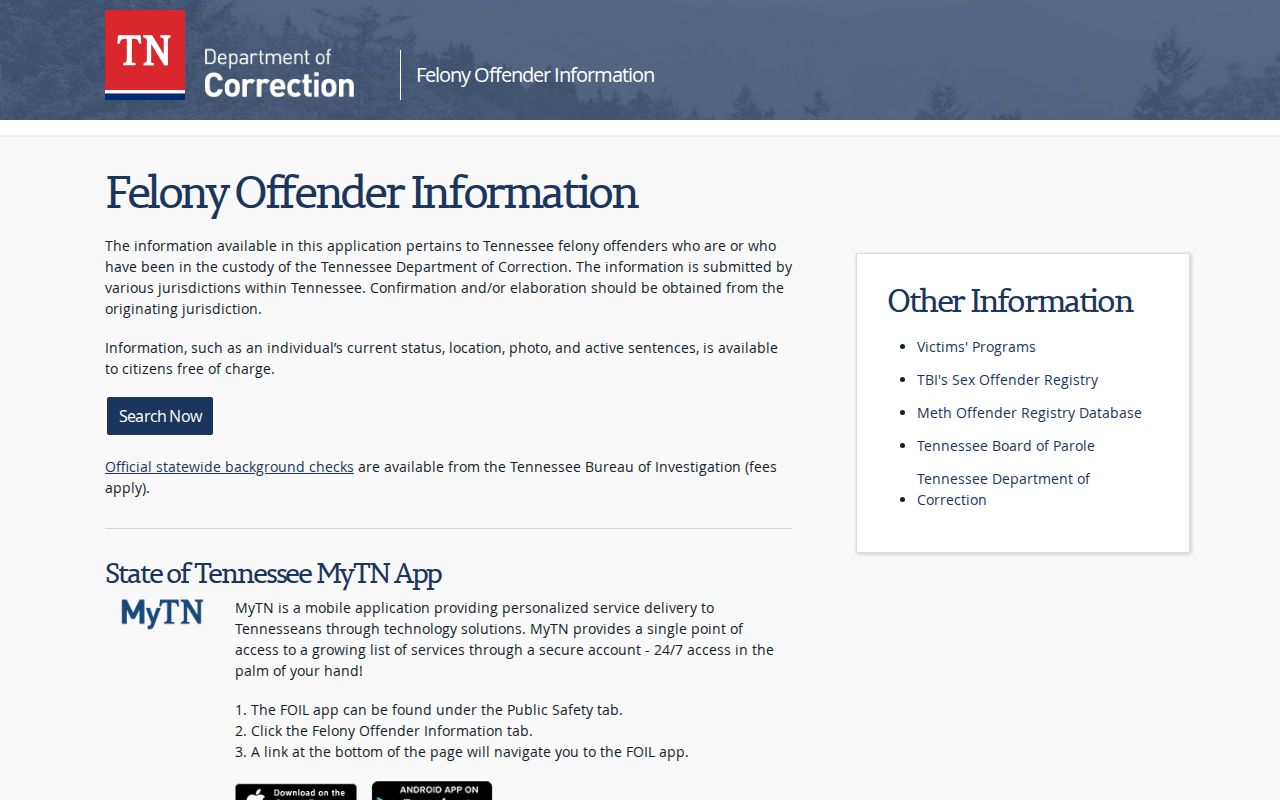
Use the sentencing court file when a public status label needs the context of the judgment or a later revocation order.
Federal custody is separate. The Bureau of Prisons locator does not search Scott County jail or most TDOC records. For Tennessee parole decisions, use the Board of Parole; TDOC Community Supervision handles community supervision. The Tennessee Board of Parole resource page provides the state channel for hearing and release information.

The board's public resources answer parole questions, while the Scott County court record remains the source for the original sentence.
Scott County Criminal Record Context
Crime statistics describe an agency and a reporting period, not a person's history or a town's rank. Oneida Police reported 289 offenses, 242 arrests, and a 72.3 percent clearance rate for 2022. A 2021 TBI overview for the Scott County Sheriff's agency listed 396 offenses and 711 arrests. The years and jurisdictions differ, so the figures should not be compared as a current score.
The TBI CrimeInsight portal is the official place to choose an agency and current available reporting period.
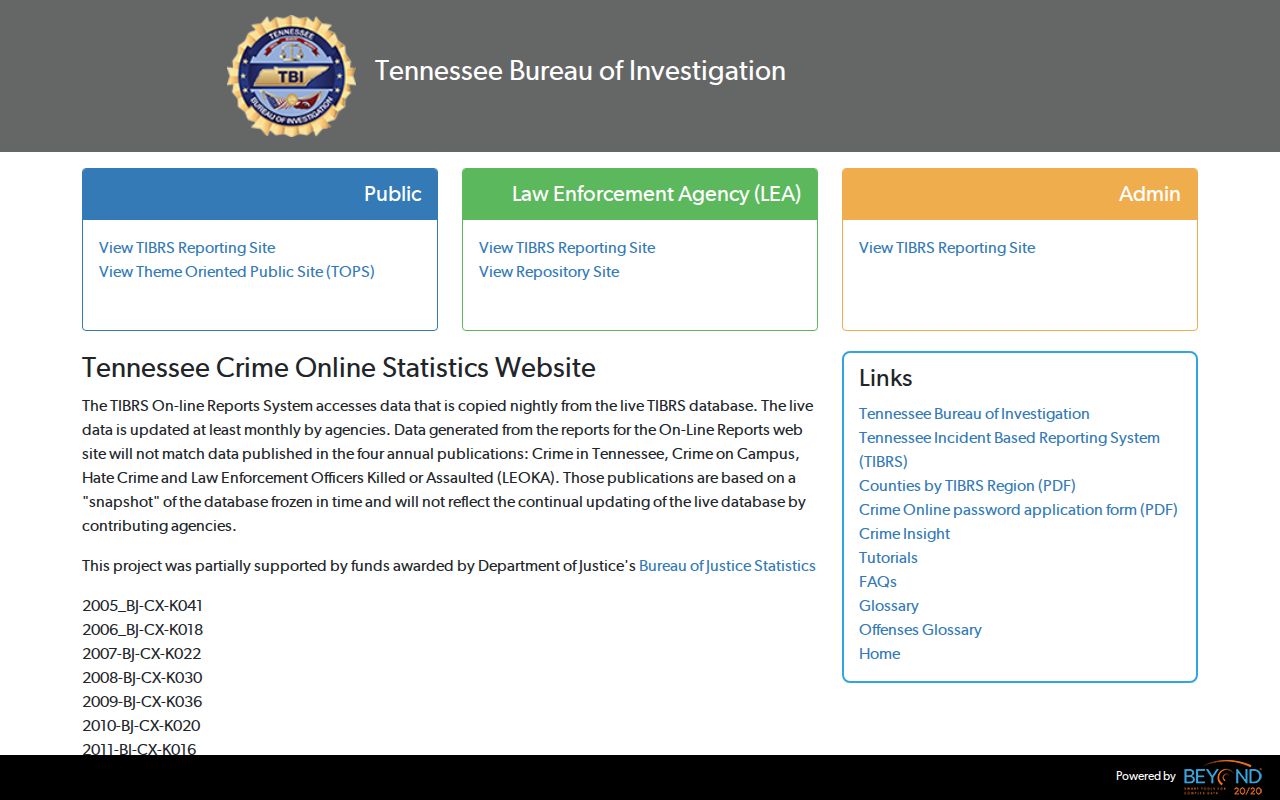
Use the portal's coverage labels and year with every figure. Reporting practice, jurisdiction size, demographics, and case clearance rules can all affect the totals.
City-by-City Criminal Records in Scott County
Scott County has three incorporated municipalities. Oneida and Winfield have police departments, so their incident reports begin with the city custodian even when an arrest later appears in county ISOMS. Huntsville has no municipal police department in the county's official inventory, and the sheriff provides law enforcement there. City pages keep those local routes distinct while pointing serious criminal cases to the county courts.
Oneida Record Check
3,787 · Police report requests and a municipal court at the Alberta Street complex
Huntsville Record Check
1,644 · Sheriff, jail, and trial-court channels at the county seat
Winfield Record Check
947 · City recorder routing for police reports and county court fallback